Latest Comments

Guest - Aislinn Dyestuff Citizen Science.
09. Oktober 2026
This is a great project. I look forward to the results. Thanks for letting us know.
Guest - Aislinn Time for...
09. Oktober 2026
Looks delicious!
Guest - Katrin Sprang Discussion
18. September 2026
Hi Rachel, I have looked for more photos of you, but that was not very successful. I found a link on...
Guest - Beatrix Sprang Discussion
15. September 2026
That lozenge pattern element is not a photograph, but a scan. So it should be to scale. But I pinned...
Guest - Katrin Sprang Discussion
15. September 2026
I was not referring to Rachel's reconstruction (is the reconstruction you refer to the one photograp...
MAI
31
0

EuroWeb: Digital Atlas is Online.

One of the goals of EuroWeb is making it easier to research textile heritage, and one of the steps for this was the development of a Digital Atlas. This has been launched recently, and you can now take a look at the Atlas here. 

It's of course a work in progress - and contributions are welcome.

And here is the launch, as the recording of the livestream:

0
MAI
30
0

Experimental Archaeology Conference 2023 - CfP

EXAR has its annual conference on October 5 - October 8 this year, and it takes place in Lauresham/Lorsch. The central topic of the conference is: "Experimental archaeology in science and education 2023". 

Registration and CfP for the conference are now open, and you can register via their website. (I haven't been able to attend for a number of years now due to timing conflicts, but the conference used to have a lot of German contributions, and last year's conference programme lists exclusively German titles for the contributions. So the conference probably makes you happier if you have good enough German language skills.)


0
MAI
26
0

A Very Helpful Cat.

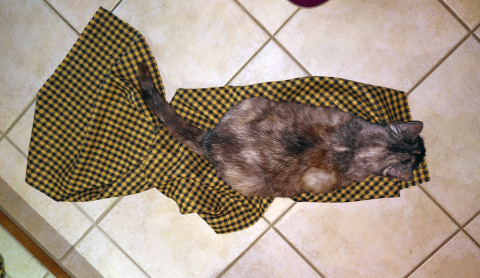
Let me show you a very helpful cat: 

What I wanted to do is try and see how that piece of cloth folds up into something that might be used as headwear.

What I ended up doing for a bit was petting the cat, who instantly appeared when I put the fabric on the floor, sat down and started to groom herself. Because that's what you do. Right?

(I did get to try out stuff a while later, when she decided that there's other places more worthy of her being there...)

And with this, I wish you a nice weekend and (if you have it) a nice bank holiday on Monday!  

0
MAI
25
1

Things I Did Today.

Things I did today? Had coffee. (Obviously.) Got blood drawn for a check-up of hormone levels (we will see if there's some adjustment needed, or if things have become stable inside the "good values" area). Served the cat more food. Sorted through the things I used at the demonstration last Sunday, to tidy them up and make life easier when the next demo starts.

Looked through some books for research purposes. Had lunch and more coffee. Repaired my phone (the bottom module was broken, so it was only charging very, very, veeeeeery slowly). Found out I also have to replace the SD-Card (it has digested some pictures, it's not supposed to do that). 

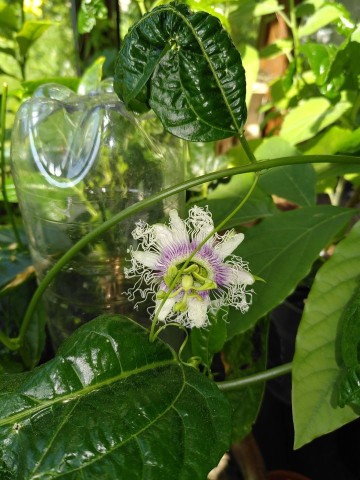
Admired the first flower of my passionfruit plant:

I doubt that there will be actual fruit coming from this, as it's the only one for now - there's a second bud on the plant, but it is still closed.

Then there was some organisatorial stuff for the next European Textile Forum. Since our long-time trusty catering company does not exist anymore, gettting the group fed has turned out to be a little tricky, so I'm still looking for a good successor to Frau Schröder (who was fonder of canned pineapple than I am, but that was never a real problem). There was also some work done on the CfP (which is due out soon, very soon).  

And now? Some emails to take care of - and then we're having a public holiday on Monday, it being Pentecost, so I'm already looking forward to a long weekend...

0
MAI
24
0

The more you look...

I've been looking, again, at headwear in medieval women - a thing I already did what feels like ages ago. Back then, I ended up with a reconstruction on how to do a barbe and fillet that I found satisfactory. I also looked at headscarves or kerchiefs or however you want to call them.

There's so, so many of these images in manuscripts that it's probably impossible to look at them all. Many of them show similar styles, with some rather typical arrangements of the ends of the headwear, and typical arrangements of the folds - so it seems like there were a few more or less common types, or common (or similar) ways to arrange the cloth on the head.

In some cases, you can see very nice regular folds on the forehead and at the sides. My interpretation of this is sewn-in folds - which will form a rectangular piece of fabric into something more bowl-shaped so it will fit (and sit) nicely. I've sewn folds into my headcloth for a long time now, and it really works very well.

But then, there's also images like this:

Fol 14r of Ms 105 Noviss 2f, Wolfenbütteler Digitale Bibliothek.

The image is from the Evangeliar Heinrichs d. Löwen und Mathildes von England (Cod. Guelf. 105 Noviss. 2°), and there's a lot of similar headdresses in there. Which makes me wonder... what material was used? How would you get folds like this? How are they fixed? Is that cloth tucked behind one ear, or is it just coincidence? So many questions.

Some trials may have been going on here... I've not arrived at a good solution yet, though.

0
MAI
23
0

Excitement!

Yesterday had a bit of extra excitement added - when I came home from bringing the post to the post office, there was more buzzing than usual in our garden. There's usually a lot of bees hanging out on our flowers, so there's a bit of a sound carpet there all the time - but this time around, the sound was coming from the willow fence, and that is a place that's not usually abuzz.

The reason for it? There was a bee swarm on the fence, almost next to the garden door.

(I wanted to post a video of the swarm, but it refused to upload... sorry, folks.)

It's more or less the typical time for bees to swarm - which is how, back in the day when they were still wild bees, they proliferated. When there's enough food and the weather is warm and dry and the old queen has been laying a lot of eggs, the workers go ahead and get some new queens started. And then the old lady takes a good part of her bees and flies off to find a new home, leaving the cozy, well-equipped place to the young one.

Because it's obviously not the queen's job to find the new home, she hangs out with most of her staff protecting her. Meanwhile, scouts are flying out to find something nice to live in. Once they come back successfully, and a committee of bees has agreed that the new home is acceptable, the swarm goes there to start a new life.

Well. Add in some hundreds of years of domestication and breeding, plus the relatively new parasite (the varroa mite), and what worked for the wild bees in theory does not work for the modern honey bee anymore. The swarming out does, yes, but there's not so many places where they could settle these days, and even if they find a hollow tree trunk or something similar, the odds that the hive will survive the winter are about... zero. The mites will take care of that.

Fortunately, our neighbour (who has bees) was home, and he had a spare box, and a catching bag, so he came over and got the swarm to give them a new home. That was a nice addition of a little excitement to the afternoon for all of us - me, the neighbour, and the bees!

0
MAI
22
0

Tick Season.

Tick season is here again - at least in our area it has started, the cat brought the first illegal passenger back home weeks ago.

In case you're in an area with ticks, check if your vaccination is still valid... and in case you're in Germany and in a region with ticks, you might want to check out the project by the RKI Germany, which is collecting ticks for a survey about species (including new ones settling in here) and the pathogens they might carry.

You find more information on the site about the Zeckenatlas Deutschland, including info on how to send in the little bastards. 

0

By accepting you will be accessing a service provided by a third-party external to https://www.pallia.net/

Kontakt