Latest Comments

Guest - Aislinn Dyestuff Citizen Science.
09. Oktober 2026
This is a great project. I look forward to the results. Thanks for letting us know.
Guest - Aislinn Time for...
09. Oktober 2026
Looks delicious!
Guest - Katrin Sprang Discussion
18. September 2026
Hi Rachel, I have looked for more photos of you, but that was not very successful. I found a link on...
Guest - Beatrix Sprang Discussion
15. September 2026
That lozenge pattern element is not a photograph, but a scan. So it should be to scale. But I pinned...
Guest - Katrin Sprang Discussion
15. September 2026
I was not referring to Rachel's reconstruction (is the reconstruction you refer to the one photograp...
APR.
17
0

Spring is Here.

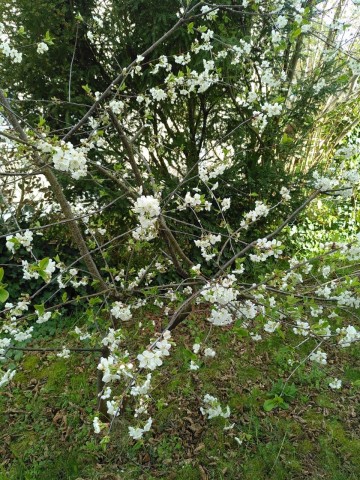
It's getting spring-timey in earnest - the cherry trees are in full bloom now: 

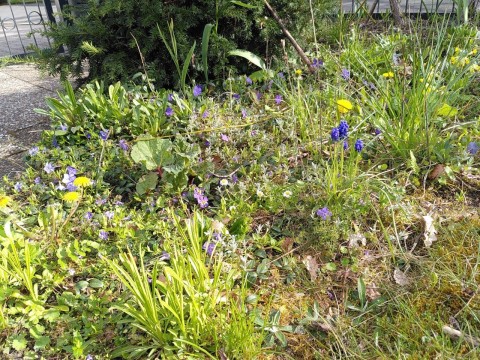
There's also a good amount of flowers doing their job: 

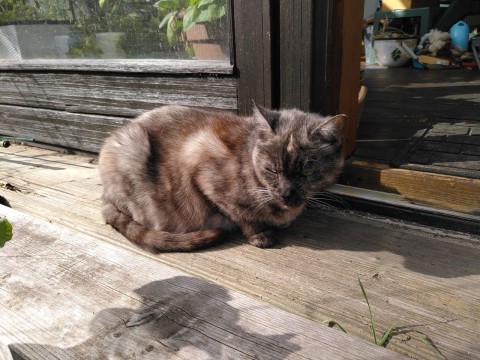
And the little cat is, of course, also enjoying the good weather. She's been having some health issues recently, some of them related to food intolerances getting worse as she ages, and some of them probably related to stress with other cats outside, so it's nice to see her relax and enjoy some sunshine. (We're working on both her health issues, and there's been some improvement already, but Madame does not find all the food that is good for her delicious enough for her palate. Sigh.)

0
APR.
14
0

Teaching Thoughts.

I've been thinking about teaching again recently - because of teaching some more again, in different settings, and because of an upcoming conference where I will do and give a short presentation about the topic.

Teaching is fun, and fascinating, and has its own special challenges and rewards. There are some things that are easier to teach and some that are harder. Personally, I find that the hardest technique to teach from the many textile techniques that I have on offer is filet netting. The knot, once you have it in your muscle memory, is not hard to do. It's a nice, fluid set of motions resulting in a nice tight knot that has the correct size every time.

However... there is no good way to split up that set of motions, at least I have not found any way to do that yet. To form the knot, you have to do all the motions and all the passes over and under the different threads, and you have to do all of them correctly. So learning that knot requires you to memorise the whole sequence in one go, which, according to my experience teaching this, is a significant challenge.

I remember learning how to do that knot myself; I used the instructions provided by Therèse de Dillmont in her book, the Encyclopaedia of Needlework, and I read them bit by bit following the sequence for many, many times until the whole process had settled in my brain. 

So - teaching long, complex (sort of) sequences that have to be done in one block is definitely a challenge - but it is something that can be taught. Other things just cannot be taught (as in directly giving instructions or passing on sequences of movements) at all. In some cases, the difference between individual bodies means that every body needs an appropriate solution for a given problem; one may work for many or most of them, but not for all. In these cases, you can only assist. 

My favourite example for this is tensioning the yarn when knitting Continental style. For most knitters (according to my own anecdotal evidence of looking on hands), wrapping the yarn around the left forefinger works very well. Many knitters wrap twice, some once, some even three times, and the number of wraps may also depend on the yarn. So this is the way how to tension yarn that most people get shown and taught when they start out knitting. 

However... for some people, it does not work. That includes me - if I wrap the yarn around my forefinger, it just won't slide at all, and I get higher tension all the time, or if I jerk more of the thread loose, uneven tension. For me, it works wonderfully to just weave the working yarn through the fingers of my left hand: over the ring finger, under the middle finger, and over the forefinger. When I was learning how to knit, finding my personal way for tensioning the working yarn was actually one of the biggest challenges, because nobody showed me that method; I stumbled across it when trying out different possibilities.

So as a teacher, you can be aware of the possibility that a given method or process might not work for everybody because of physical reasons - and then you can, if you know of alternatives and options, tell about the other possibilities that the student could try. But of course you cannot slip into their skin and try out the options yourself to see which one feels best, and you might not be able to demonstrate the other options well as they might not work well, or at all, for you. In the end, they will have to find their own solution by trying out things. 

Have you come across similar things - in learning a skill, or in teaching? I'd love to know!

0
APR.
13
0

New Book!

One of my lovely colleagues has a new book out - Maria Mossakowska-Gaubert has written a monograph about monastic (not only monastic, though) garments and Greek terminology. Here's her description of it: 

This book focuses on clothing customs and their evolution in the Egyptian monastic environment of late antiquity and the early Arab period. It falls within the realm of studies on ancient societies as seen through their languages, material culture, daily life and religious practices. The research presented here contributes to a general discussion on the clothing worn in Egypt and its role as a social marker. The designations and forms of monastic vestments are explored through a meticulous lexicographical study and an investigation of the garments that have been preserved or are represented in iconography, in order to place them in the context of ancient "fashion" and to shed light on the technological changes that affected their production.
The idea of a costume specific to the monastic rank seems to have appeared in Egyptian society in the middle of the 4th century. This "official" garb was reserved for special situations, such as participation in the liturgy, while "ordinary" garments were worn by the monk for everyday tasks and for sleeping. Considered separately, the elements that made up the "official" attire were commonly worn at this time (with the exception of the apron and scapular), and it was only when worn together that they distinguished a monk from a layman.

The book is titled Le vêtement monastique en Égypte (IVe-VIIIe siècle) and has been published by the Ifao, in the series Bibliothèque d'études coptes, no 28. 

0
APR.
12
0

CfP - Dyes in History and Archaeology

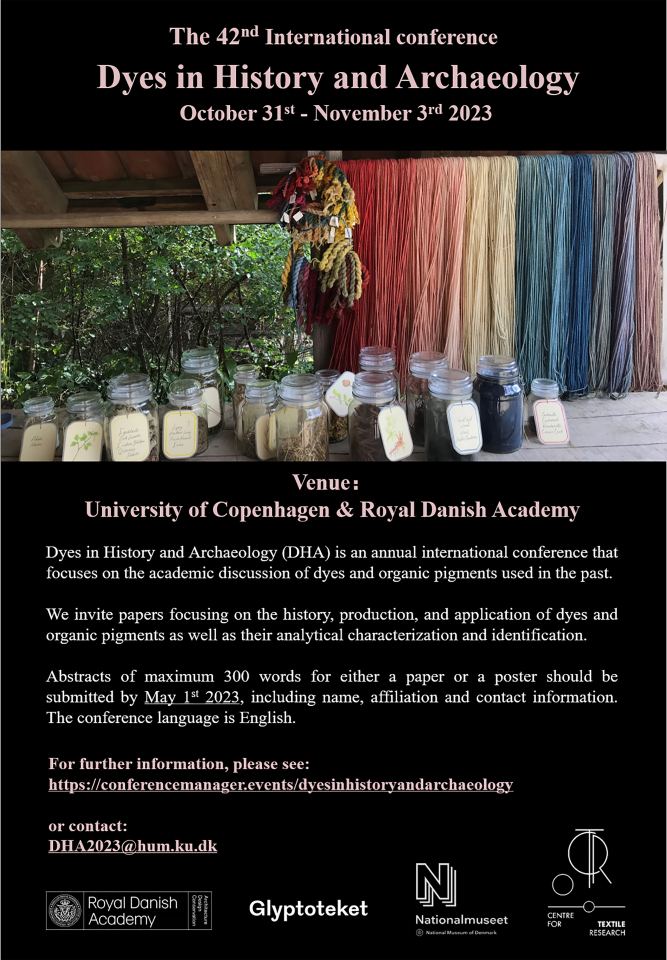
If you like colours, especially those of the past, well, here's a Call for Papers for you: 

The CTR, The Ny Carlsberg Glyptotek, The National Museum of Denmark, and The Danish School of Conservation are jointly hosting this year's conference on Dyes in History and Archaeology (DHA 42) in Copenhagen from October 31st to November 3rd.The call for abstracts is open with the deadline being the 1st of May of 2023, so please consider sending your proposal! 

Here is the link for the conference website with all the necessary information: Dyes in History and Archaeology 2023 DHA42

I'm very, very tempted every year to go to this conference... even though I'm no dye specialist. But, well, the colours! The chemistry! The magic! I won't manage to go there this year either, as it's way too close to the European Textile Forum week and I will be doing the necessary prep work at that time, but some day I will surely make it.  

0
APR.
11
0

Is it Tuesday already?

Well, that time passed quickly...

There was colouring of eggs, and nice leisurely breakfasts, and some cooking, and some meeting with friends, there was the first ice cream parlour visit of the year for coffee and, you may have guessed it, icecream.

I finally managed to sow some more seeds, and there was even time for a bit of gardening. Like always, though, there's a bunch of work left to do, and the Easter holidays could have been twice as long without us getting bored.

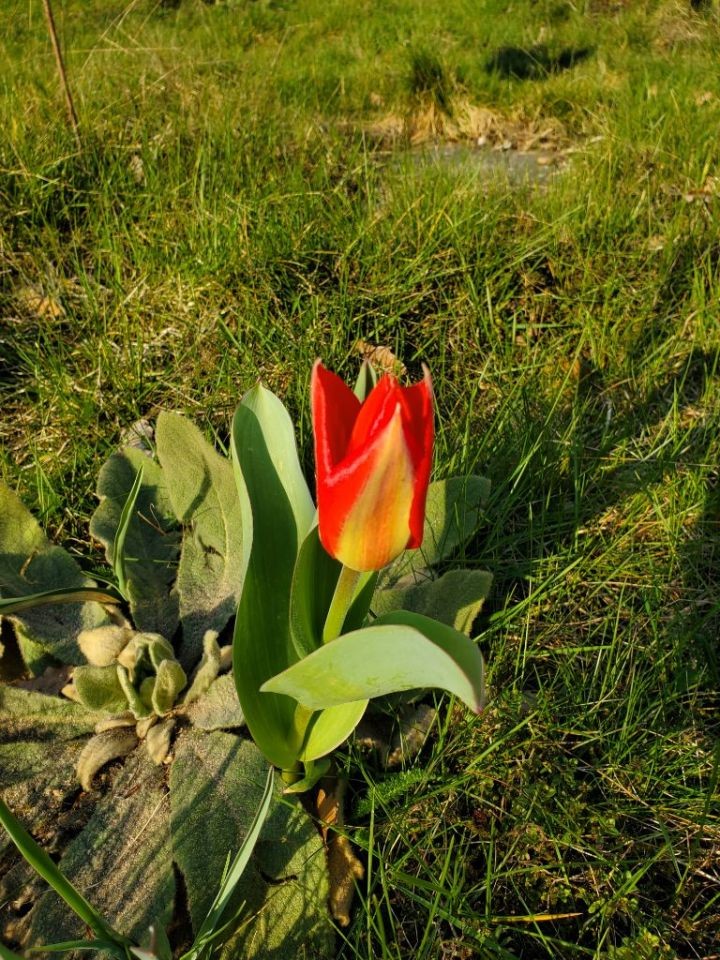
Now it's back to work, but at least I have a nice view on the tulips blooming in the garden - the first ones are already sticking out of the lawn and in full bloom. (Since we are not really mowing the lawn anymore during spring and summer, I stuck some of the tulip bulbs that were not thriving in their former place into the lawn last year - and it looks like they are much happier there!)

There's a bunch of other flowers too, and the neighbour's bees are visiting them with gusto.

Oh, and speaking of bees - now is the time when they also need water, so if you want to help your neighbourhood bees, you can provide them with a source of water where they can safely land and drink. A flat bowl with rough surface will do, or a large jar with enough wood sticks or twigs stuck into it that the bees can land on the wood and crawl down to the water.

0
MäRZ
24
1

Karlsruhe! Nadelwelt!

I'm deep in the preparation for the Nadelwelt fair next week. It's amazing how, shortly before a fair, there's always this and that coming back to mind that could be done, or that would be nice to have on the fair, in addition to all the other things that have to be prepared, or made, or checked.

Weird, isn't it? 

I've made good progress today, both with checks of lists, and getting things sorted, and with more preparation. Like restocking on distaffs, which means finishing their top ends with a knife and fitting them with the band. Still plenty of things left to do, though...

The Nadelwelt! We will be in B6.5 this year. Drop by if you are there, and say hello!

... which means that I will be taking a little blog break. 

The fair runs from Friday, March 31, to Sunday, April 2 (come visit me and Margit at our booth in B6.5!), so after packing everything up, I'll be back home on Monday... and then it's almost Easter already. Which means I will be back on the blog after Easter, on April 11. 

Have fun, and happy egg hunting if you do!

0
MäRZ
23
0

Travel Planning, Roman Style.

Just in case you, like me, are planning travels (there's conferences and workshops coming up, and I'm looking into options for getting there and back again) but would like to try and see how it would be Roman Style... here's a Route Planner based on the Tabula Peutingeriana, which is a medieval copy of a Roman map.

There you go. But don't expect the planner to provide you with routing to the nearest airport! ;) And if you prefer looking at the real thing, here's the digitised version in the Austrian National Library.

0

By accepting you will be accessing a service provided by a third-party external to https://www.pallia.net/

Kontakt