Latest Comments

Guest - Aislinn Dyestuff Citizen Science.
09. Oktober 2026
This is a great project. I look forward to the results. Thanks for letting us know.
Guest - Aislinn Time for...
09. Oktober 2026
Looks delicious!
Guest - Katrin Sprang Discussion
18. September 2026
Hi Rachel, I have looked for more photos of you, but that was not very successful. I found a link on...
Guest - Beatrix Sprang Discussion
15. September 2026
That lozenge pattern element is not a photograph, but a scan. So it should be to scale. But I pinned...
Guest - Katrin Sprang Discussion
15. September 2026
I was not referring to Rachel's reconstruction (is the reconstruction you refer to the one photograp...
FEB.
16
0

Mummification.

And now for something completely different: Researchers have found out details about how corpses in Egypt were mummified. There was a number of substances used, in specific mixtures for specific parts, and we now know this due to the discovery of an embalming workshop in Saqqara, dating to the 26th dynasty.

You can read more about it in this Open Access article at nature.com, or if you prefer a short German summary, here is one.  

(I think I'd still prefer to get buried in a grave mound instead of getting mummified and put into a pyramid...)

0
FEB.
15
0

Tassel Threads.

I'm still working (of course) on the presentation for Syke, and it's really nice to revisit all the things that went on in that project. As usual, I'll have to cut some (or what feels like a lot, actually) of the things I'm putting into the draft of the presentation. There's so much that I could probably speak about it for half a day...

One nice thing about looking back on a project like this is that it's easy to remember all the fun bits and sort-of-forget about the annoying ones. At some stages, things just felt like they would never ever end... it was a lot of cords, and a lot of rings for the ends of the cords, and a lot of loops to sew onto the cloak. But it did end, eventually.

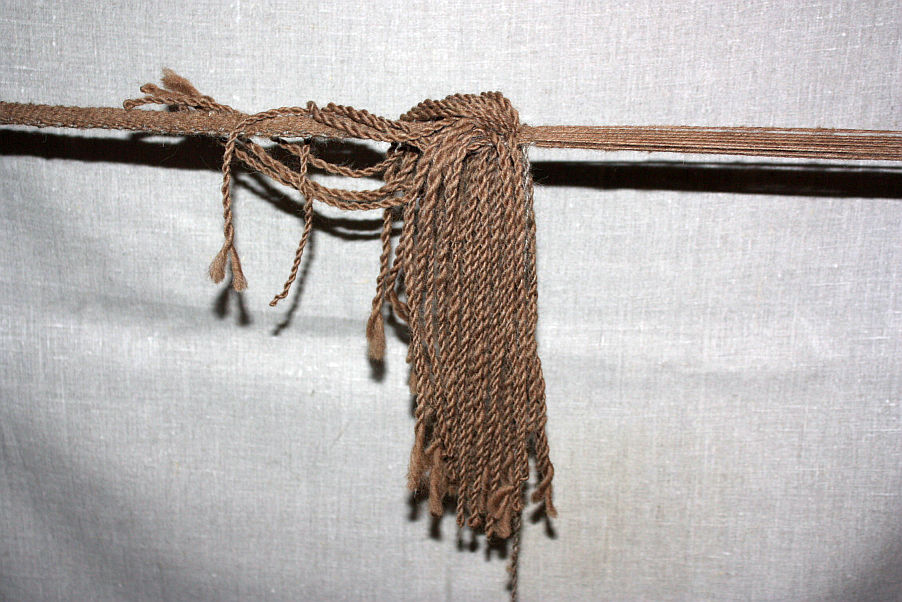
And because I've been revisiting pictures, here's one for you from the selection going into the presentation.

This is the end of the belt reproduction from the Egtved find. It has a tassel at the end, formed by cords finished in (you guessed it) rings. These rings are then gathered together so the whole thing forms a cone shape - surprisingly stiff, and quite stunning. The puny number of just 20 warp threads would, of course, not be enough for a nicely sized tassel like that, so the weaver solved the problem by adding in some more cords at the end of the belt weave. That's exactly what can be seen in this photo: The extra threads inserted, and there's already a few more wefts done to keep them in place.

After finishing the belt weaving, they were then corded, and then the belt provided me with the opportunity to get into ring-wrapping... but that's another story.

0
FEB.
14
0

Planning, Writing, Drinking Tea.

Things going on here today? The usual day-to-day boring stuff. Trying to figure out some dates for conferences, travel, holidays, and online courses for the next months. Packing up stuff ordered in the shop to get it sent out. Writing for the presentation in Syke about the Bronze Age garments reconstruction.

It's a lot of fun to re-visit all the stages of production, and the images taken. I'm also slowly getting to the point where I have something like a plan on how to present the various individual pieces, and where and how to give the basic information for those in the audience who are not textile specialists. That is one of the challenges when doing a presentation for a completely unknown audience - you want to give enough basic explanations on what you are talking about so that everybody can follow, but it can't be too long or too elaborate, and you don't want to bore the part of the audience who already knows about it. For instance, I can't assume that everybody will know how weaving works in general, or on a warp-weighted loom specifically - so I have to explain this, because some understanding of the loom and the process are necessary to understand one of the characteristics of the large textile pieces: the weft crossings where several weavers worked together. Fortunately I also made the belt, and I have a video and pictures of that, so I can explain the basics here and then go on to the larger fabric, and the loom. 

Getting these presentations done takes quite a bit of time, especially as the ideas need to get sorted out, the sequence has to be found, and everything needs a day or two inbetween to settle in my head and organise itself. Good thing there's still a few days left before I have to finish!

I'm also trying to figure out if now is a good time to treat the peach tree against its curly leaf syndrome, or if it would be better to wait another one or two days. I find this always hard to tell. Last year I didn't catch the correct point in time, and there were lots of very, very curly leaves. There were still some peaches, but I can't say if the number of them had something to do with the tree not doing well, or the weather, or something else.

All this, of course, fueled by tea. Because everything is better with tea. Except when it's better with coffee... which is also being consumed. Why stick to one source of motivational caffeinated hot drink, after all, if you can have two?

0
FEB.
10
0

A Bit of Jane Austen.

I'm one of the many, many fans of Jane Austen's works. I can't really say what makes her books so fascinating to me (well, apart from Emma, which does exactly what the author intended it to do, that is get on my nerves via the insufferable protagonist). Is it the glimpse into a world of the past, but not so far in the past that there's too much conjecture? The slightly different etiquette and societal rules? Or the fact that, in the end, it's straight-up lovely happy-endy chick lit, and thus just a read that's good for the soul?

In the end, it doesn't really matter. I've read Pride and Prejudice, which is my favourite of her books, more times than I remember to count, and we have several versions of it as a film, and those do get viewed again and again too. 

If you like Jane Austen stuff, maybe this video about some of her surviving letters, showing a glimpse of her personal life, will delight you as well:

0
FEB.
09
0

Bronze Age Garments - Presentation

You remember the Bronze Age garment reconstructions that I made, based on the finds from Egtved and Trindhøj? Well, I'm utterly delighted that they are very well received by the public at the museum in Syke - so well that there's a demand to hear more about it, and thus I will be travelling up North to give a little presentation on how they were made.

That is taking place on February 23, starting at 18:30, in the Forum Gesseler Goldhort in Syke... 

If you're interested and in the area, you can reserve your place here!

0
FEB.
08
0

EuroWeb Book Talk: "Paul Gout's 157 Colours"

It's a little short notice - but: Are you interested in historical textile dyes, dying crafts and colours in general? Then you might be interested in the EuroWeb Bookcorner this afternoon!

Dominique Cardon, one of the foremost experts on historical dying and the history of colour, presents her and Iris Brémauds brand new book, «Les 157 couleurs de Paul Gout/ Paul Gout's 157 colours» (Les Mots qui portent, 2023) today (February 13) at 16:00 CET.

Registration for this new installment of the EuroWeb Book Corner is necessary to attend, but it's free. You can register here: https://bit.ly/3JDqVPx
 

0
FEB.
08
0

EU Citizen Science prize fund

I've recently gotten a heads-up about a funding possibility for citizen science. Well, funding in the sense of you have to win the competition, but still, it's a possibility! 

Here's the description, with links: 

€100,000 prize fund for new EU citizen science competition

The EU is holding the competition for citizen science researchers annually from this year on. The closing date for submissions is 13 March.

As part of a bid to get the public involved in science research, the EU launched a competition 10 January with a grand prize of €60,000 and an overall prize fund of €100,000. The European Union Prize for Citizen Science competition is being overseen by Ars Electronica, an Austria-based scientific and education institute. There is no entry fee.

This is the first time the EU has held a citizen science-focused contest on such a large scale. The EU's aim is to celebrate and reward ordinary people doing extraordinary things in science. Lay people who dedicate themselves to scientific research outside of their regular professional lives are often referred to as citizen scientists.

Many of the world's most famous discoveries and breakthroughs have been made by citizen scientists. Professional scientists often rely on and collaborate with lay scientists, particularly when it comes to solving problems. Over the past few months in Ireland, citizen scientists have been called on to help with projects ranging from red squirrel revivals to air quality monitoring . In May 2022, the European Space Agency called on the public to help astronomers spot changes on the surface of a comet they had studied for some years.

As well as the grand prize of €60,000, the new EU competition will grant two other awards. The Diversity & Collaboration Award is worth €20,000, as is the Digital Communities Award. There will also be 27 honorary mentions made as part of the competition. The awards will be made by a jury, who will meet in April to review the submissions. Those interested in entering this year's competition can do so until the final closing date of 13 March 2023. The awards ceremony will take place in September, following the winners announcement in June.

From now on, the competition will be held annually by Ars Electronica, with funding provided via Horizon Europe, the EU's research and innovation fund.

More information about entering the European Union Prize for Citizen Science is available on Ars Electronica's website.

0

By accepting you will be accessing a service provided by a third-party external to https://www.pallia.net/

Kontakt